
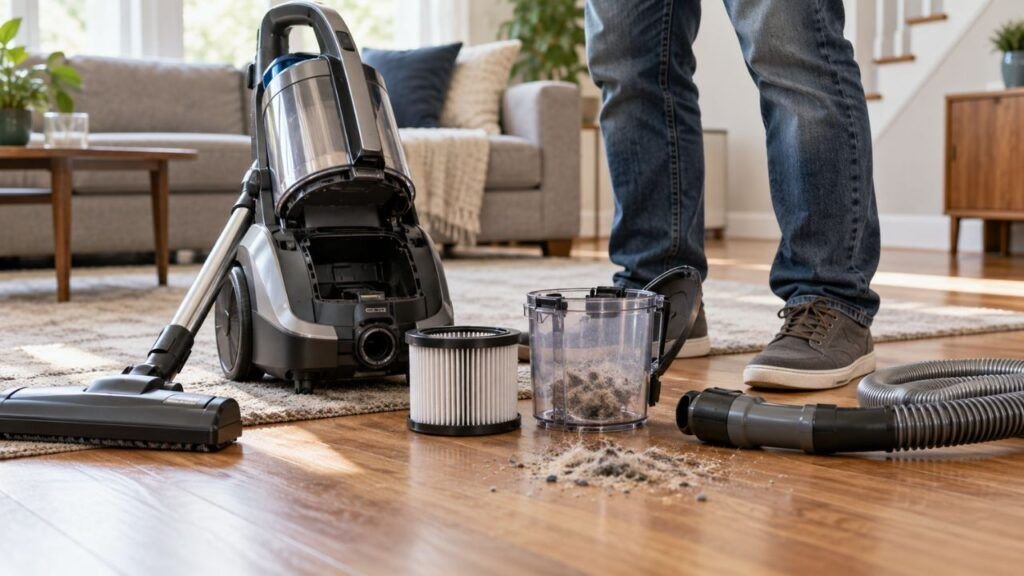
A vacuum cleaner usually loses suction because airflow becomes restricted or air escapes somewhere. A full dust bin, dirty filter, clogged hose, or leaking connection causes most suction problems.
Fortunately, many suction problems are easy to diagnose at home. This guide explains what causes weak suction, how to find the problem, and how to restore your vacuum’s cleaning performance.
Key Takeaways
- A full dust bin or bag can quickly reduce airflow.
- Dirty filters are among the most common causes of weak suction.
- Hose, wand, and floor-head blockages can restrict airflow significantly.
- Cracked hoses or loose seals allow unwanted air into the system.
- Poor debris pickup does not always mean actual suction has decreased.
- Brush roll or belt problems often affect carpet cleaning performance.
- Persistent overheating or unusual motor noises may require professional repair.
Why Does a Vacuum Cleaner Lose Suction?
A vacuum cleaner depends on steady airflow through a mostly sealed pathway. The motor moves air through the floor head, hose, filters, and dust container.
When something restricts that pathway, less air reaches the cleaning head. Suction therefore feels weaker where you need it most.
Air leaks can cause similar problems. A cracked hose or poorly fitted dust bin lets outside air enter. That reduces the pressure available for lifting debris from your floors.
It is also important to separate suction from overall cleaning performance. Your vacuum might have strong airflow while still struggling with carpet debris.
For example, a tangled brush roll cannot agitate carpet fibers properly. The vacuum may feel weak even though its suction remains normal.
Quick Vacuum Suction Troubleshooting Chart
The symptoms you notice can help narrow down the problem quickly. Start with the closest matching symptom before taking anything apart.
| What You Notice | Most Likely Cause | Check First |
| Suction gradually became weaker | Dirty filter or filling bin | Bin and filters |
| Suction suddenly disappeared | Major clog or loose connection | Hose and airflow path |
| Hose suction feels strong | Floor-head or brush problem | Floor head |
| Vacuum whistles or hisses | Air leak or blockage | Hose and seals |
| Suction fades after several minutes | Restricted airflow or overheating | Filters and clogs |
| Poor carpet pickup | Brush roll, belt, or height setting | Floor head |
| Weak suction after washing filter | Damp or incorrectly fitted filter | Filter installation |
| Cordless vacuum feels weaker | Filter, blockage, or power setting | Airway and settings |
| Nothing improves suction | Internal fan or motor problem | Professional diagnosis |
How to Find Where Your Vacuum Is Losing Suction
You can often locate a suction problem before replacing anything. Work through the airflow path from the vacuum body toward the floor.
Turn the vacuum off before removing hoses, wands, or floor attachments. Unplug corded models and remove removable batteries when possible.
Check Suction at the Main Airway
Start by disconnecting the hose or wand from the main vacuum body. The exact process depends on your vacuum’s design.
Turn the vacuum on briefly and check airflow at the main opening. Avoid placing fingers or loose clothing inside the opening.
Strong airflow suggests that the motor and main airflow system are working. Weak airflow means the problem probably sits inside the main unit.
If Suction Is Strong
Strong suction at the main unit usually narrows the problem considerably. Something farther along the airflow path may be interfering.
Check these areas next:
- Vacuum hose
- Extension wand
- Floor-head airway
- Floor-head connection
- Brush roll
- Drive belt
A blockage near the floor head is especially common with larger debris.
If Suction Is Weak
Weak airflow directly from the main unit points elsewhere. Start with components that directly control airflow.
Check:
- Dust bin or vacuum bag
- Pre-motor filter
- Exhaust filter
- Cyclone separator
- Internal inlet
- Dust-bin seal
- Filter compartment
- Motor airflow
Always finish the basic maintenance checks before suspecting motor failure.
Common Reasons Your Vacuum Cleaner Loses Suction
Most weak-suction problems come from a small group of causes. Start with simple airflow restrictions before considering expensive repairs.
1. The Dust Bin or Vacuum Bag Is Too Full
A vacuum needs room for air to move through its system. An overly full container restricts that movement and reduces cleaning performance.
Bagless vacuums normally have a maximum fill line on the container. Empty the bin before debris becomes tightly packed above this point.
Bagged vacuums can lose airflow before the bag appears completely full. Fine dust can fill the bag’s pores and restrict airflow.
For better performance:
- Empty bagless bins regularly.
- Follow the marked maximum fill line.
- Replace vacuum bags when airflow starts decreasing.
- Check that replacement bags are installed correctly.
- Remove debris around the bin inlet.
2. The Vacuum Filters Are Clogged
Filters trap fine particles before they reach sensitive vacuum components. Unfortunately, that same dust eventually restricts airflow through the filter material.
Many vacuums contain more than one filter. You might have a pre-motor filter and another exhaust filter.
A filter can look reasonably clean while containing fine embedded dust. This is especially common after cleaning carpets, pet areas, or dusty rooms.
When servicing filters:
- Check your vacuum’s manual first.
- Wash only filters specifically labeled washable.
- Never reinstall a filter while it remains damp.
- Replace damaged or heavily clogged filters.
- Check every filter location in the vacuum.
Do not assume every HEPA filter can be washed. Some must remain dry and require replacement instead.
3. The Hose or Wand Has a Blockage
Vacuum hoses create narrow pathways where larger debris can become trapped. One blockage can dramatically reduce airflow through the entire vacuum.
Common items include hair, paper, pet fur, socks, and small toys. Debris often gets stuck near bends or hose connections.
To check the airway:
- Disconnect the hose and wand.
- Look through each section toward a light source.
- Check curved joints carefully.
- Remove visible debris gently.
- Use only blunt tools when necessary.
- Avoid sharp objects that could puncture the hose.
A partially blocked hose may still pass some air. This can make the suction problem harder to notice immediately.
4. The Floor Head or Intake Is Clogged
The floor head handles almost everything your vacuum collects. Its narrow passages can therefore become blocked surprisingly quickly.
Look around the opening where the floor head meets the wand. Hair, paper, and larger objects frequently become stuck around this area.
Also inspect the intake behind the brush roll. A dense collection of hair or debris can reduce airflow before dirt enters the hose.
Remove anything obstructing the pathway before reassembling the vacuum.
5. The Cyclone or Internal Dirt Separator Is Packed With Dust
Bagless vacuums commonly use cyclones to separate dirt from moving air. Fine dust can gradually collect around screens and cyclone openings.
That buildup may restrict airflow even after emptying the dust bin.
Remove the dust container and inspect all user-accessible separator areas. Clean only components your manufacturer identifies as removable or washable.
Avoid forcing tools into internal cyclone passages. Damaging those parts could make the suction problem worse.
6. The Hose, Dust Bin, or Seals Are Leaking Air
A vacuum works best when its airflow pathway remains properly sealed. Even small leaks can reduce suction at the cleaning head.
Possible leak locations include:
- Cracked flexible hoses
- Loose hose connections
- Worn hose cuffs
- Misaligned dust bins
- Loose filter covers
- Damaged rubber seals
- Incorrectly installed filters
- Poorly connected wands
Listen carefully while the vacuum runs. A new whistling or hissing sound can indicate escaping air.
Run your hand near hose connections without touching moving parts. You may feel air entering through a loose connection.
7. The Suction Control or Floor Setting Is Wrong
Sometimes nothing is actually wrong with your vacuum. One incorrect setting can make the machine appear much weaker.
Check whether your vacuum has:
- Adjustable suction control
- Eco or low-power mode
- Carpet-height adjustment
- Hard-floor mode
- Brush-roll controls
- Suction relief valve
Some uprights perform poorly when the floor height is incorrect. Too much clearance reduces effective pickup from carpets.
Setting the head too low can also create problems. The vacuum may become difficult to push and airflow can suffer.
8. The Vacuum Is Overheating
Restricted airflow can cause heat to build inside a vacuum. Filters, blockages, or packed dust containers are common contributors.
Some models may shut down or change performance when temperatures rise. Others may simply become unusually hot during operation.
If suction weakens after several minutes, stop using the vacuum. Let it cool before checking filters, bins, hoses, and airflow passages.
Repeated overheating should not be ignored. Continued excessive heat can eventually damage internal components.
9. The Motor or Fan Has a Mechanical Problem
Motor problems are possible, but they should not be your first assumption. Most suction problems come from simpler airflow restrictions.
Internal fan damage can reduce the amount of air moving through the vacuum. Worn bearings or electrical problems can also affect motor performance.
Motor problems may cause additional symptoms such as:
- Grinding noises
- Screeching sounds
- Burning odors
- Excessive vibration
- Unusual heat
- Repeated shutdowns
- Visible sparks
Stop using the vacuum if you notice serious electrical symptoms. A qualified technician should inspect internal motor problems.
Does Poor Pickup Always Mean the Vacuum Has Lost Suction?
No. A vacuum can produce strong suction while still leaving debris behind. Carpet cleaning also depends heavily on the floor head and brush system.
Tangled or Jammed Brush Roll
The rotating brush helps loosen dirt trapped inside carpet fibers. Hair and thread can eventually wrap tightly around the roller.
When the brush stops rotating properly, debris stays inside the carpet. This can easily feel like weak suction.
Turn the vacuum off before cleaning the brush roll. Carefully remove hair, thread, and fibers wrapped around it.
Stretched or Broken Vacuum Belt
Many upright vacuums use a belt to rotate the brush roll. That belt can stretch, slip, crack, or break over time.
The vacuum motor may still produce normal airflow. However, carpet pickup becomes noticeably worse without proper brush movement.
Inspect the belt if your brush roll stops turning normally. Replace it with the correct part for your vacuum model.
Worn Brush Roll
Brush roll bristles gradually wear down through normal use. Short or damaged bristles cannot agitate carpet fibers as effectively.
Replacing the brush roll may improve cleaning performance significantly. This is especially relevant for older vacuums used frequently on carpeting.
Wrong Floor-Head Height
Upright vacuums often include several floor-height positions. The wrong setting can reduce how effectively debris reaches the intake.
Raise or lower the head until the vacuum moves comfortably. You want good floor contact without excessive resistance.
Why Does My Vacuum Lose Suction After a Few Minutes?
Suction that starts strong and weakens later often indicates increasing airflow restriction or heat buildup. The timing itself can provide a useful diagnostic clue.
Possible reasons include:
- A dirty filter becomes increasingly restrictive.
- Fine dust quickly coats the filter surface.
- A partial hose clog shifts during use.
- The dust container fills rapidly.
- Cooling airflow becomes restricted.
- Hair gradually jams the brush roll.
- The vacuum begins overheating.
- A cordless model changes power behavior.
Turn the vacuum off if it becomes unusually hot. Clear airflow problems before continuing to use the machine.
If the issue returns despite clean airflow passages, professional inspection may be appropriate.
Why Does My Vacuum Have Suction at the Hose but Not the Floor Head?
Strong hose suction usually means the motor and main airflow system are working. The problem is probably somewhere between the hose and your floor.
Check these areas:
- Extension wand for blockages
- Floor-head neck for trapped debris
- Brush-roll housing
- Tangled brush roll
- Worn or broken belt
- Loose floor-head connections
- Incorrect carpet-height setting
Remove each attachment separately when possible. This makes finding the exact restriction much easier.
If airflow remains strong through every attachment, inspect the brush system next.
Why Is My Vacuum Still Weak After Cleaning the Filter?
Cleaning a filter will not restore suction when another problem exists. The filter itself may also be improperly cleaned or installed.
First, make sure the filter is completely dry. A damp filter can severely restrict airflow and may damage some vacuums.
Next, confirm that the filter sits correctly inside its housing. An incorrectly installed filter may interfere with airflow or sealing.
You should also check whether your vacuum contains another filter. Many machines have separate pre-motor and exhaust filters.
Other possibilities include hose clogs, leaking seals, blocked cyclones, or floor-head restrictions.
Never operate a vacuum without its required filters. Removing them can expose the motor to damaging dust.
Why Does My Vacuum Work on Hard Floors but Not Carpet?
When a vacuum cleans hard floors well but struggles on carpet, suction may not be the actual problem. Carpet requires effective brush agitation alongside airflow.
Check:
- Whether the brush roll is spinning
- Hair wrapped around the brush roll
- Condition of the drive belt
- Carpet-height adjustment
- Carpet cleaning mode
- Worn brush bristles
- Floor-head blockages
Hard surfaces require less agitation because debris sits near the surface. Carpet traps dirt deeper between fibers.
That is why brush-related problems often become noticeable on carpet first.
Does the Cause Change by Vacuum Type?
The basic airflow principle remains similar across vacuum types. However, certain designs have problem areas worth checking first.
Upright Vacuums
Uprights often develop issues around the floor head and lower airway. Brush systems are also important for carpet cleaning.
Check the lower hose, brush roll, drive belt, floor-head intake, and height setting.
Canister Vacuums
Canister models use longer hoses and extension wands. Those components create additional places where debris can become trapped.
Also check suction-control vents and powered floor heads. Make sure vacuum bags are fitted correctly.
Cordless Stick Vacuums
Cordless models often have narrow airflow pathways and smaller dust bins. Both can become restricted fairly quickly.
Check the bin, filters, wand, cleaning head, and power mode. Battery condition may also affect maximum performance on some models.
Robot Vacuums
Robot vacuums do not normally have long detachable hoses. Their common problem areas are concentrated around the main cleaning unit.
Check the small dust bin, filter, intake pathway, main brush, and brush housing.
Also confirm the dust bin and filter assembly sits correctly.
How to Restore Vacuum Suction Step by Step
Start with simple maintenance before replacing expensive components. This order helps you eliminate the most likely causes quickly.
- Turn the vacuum off. Unplug it or remove the battery when possible.
- Empty the dust bin. Replace the vacuum bag when necessary.
- Check every filter. Clean or replace them according to instructions.
- Inspect the hose. Remove any visible blockages carefully.
- Check the extension wand. Look for lodged objects or packed debris.
- Inspect the floor head. Clear its intake and connecting neck.
- Clean the brush roll. Remove wrapped hair, string, and fibers.
- Inspect the belt. Replace damaged belts when applicable.
- Check seals and connections. Make sure everything clicks together securely.
- Verify the settings. Select the correct power and floor modes.
- Reassemble the vacuum. Ensure filters and bins sit properly.
- Test the suction again. Check airflow before resuming normal cleaning.
If suction remains weak at the main unit, internal servicing may be necessary.
Vacuum Suction Problems You Should Not Ignore
Most suction problems involve harmless maintenance issues. Certain symptoms, however, can indicate electrical or mechanical damage.
Stop using the vacuum if you notice:
- Strong electrical burning smells
- Smoke from the vacuum
- Visible sparks
- Grinding from the motor housing
- Screeching motor noises
- Repeated unexplained shutdowns
- Excessive heat
- Damaged electrical cords
- Liquid entering a dry-only vacuum
Do not continue running the vacuum hoping the problem disappears. Serious electrical symptoms require professional inspection.
How to Prevent Your Vacuum From Losing Suction
Regular maintenance keeps the airflow pathway clear and reduces unexpected problems. The exact schedule should follow your vacuum manufacturer’s recommendations.
| Maintenance Task | When to Do It |
| Empty the dust bin | Before reaching the maximum fill line |
| Check the vacuum bag | When airflow starts falling or bag fills |
| Inspect the brush roll | Regularly, especially with pets |
| Inspect hose and wand | Whenever suction suddenly decreases |
| Clean washable filters | According to manufacturer instructions |
| Replace non-washable filters | According to manufacturer instructions |
| Check seals and hose | Whenever suction remains weak |
| Inspect floor head | When debris pickup becomes poor |
Homes with pets may require more frequent brush-roll maintenance. Long hair can also create faster buildup around rotating components.
Fine dust places additional stress on vacuum filters. Check filters more frequently after unusually dusty cleaning jobs.
When Should You Repair or Replace a Vacuum With Weak Suction?
Many suction problems can be repaired cheaply at home. A damaged filter, hose, belt, or brush roll usually does not justify replacing the entire machine.
Simple repairs may make sense when the problem involves:
- Replaceable filters
- Damaged hoses
- Worn belts
- Brush rolls
- Loose seals
- Accessible blockages
- Replaceable floor heads
Professional repair may make more sense for internal motor problems. Compare repair costs against your vacuum’s condition and replacement value.
Replacement could be more practical when several expensive parts have failed. Parts availability also matters for older or discontinued models.
There is no universal age when every vacuum should be replaced. A well-maintained machine can remain useful for many years.
Final Words
A vacuum cleaner usually loses suction because something interrupts proper airflow. Start with the dust container, filters, hose, wand, and floor head.
If those areas are clear, check for leaking seals and incorrect settings. Brush-roll problems should also be considered when carpet pickup becomes poor.
Motor failure is possible, but it should usually be investigated last. Following the airflow path step by step often reveals the problem quickly.
Related FAQs
Can a Dirty Filter Cause a Vacuum to Lose Suction?
Yes. A clogged filter restricts the airflow that your vacuum needs for strong suction. Clean washable filters or replace disposable ones according to your vacuum manufacturer’s instructions.
Why Did My Vacuum Suddenly Lose Suction?
Sudden suction loss often points to a blockage, disconnected hose, full bin, or incorrectly fitted component. Check the airflow path from the floor head toward the vacuum body.
Why Is My Vacuum Running but Not Picking Anything Up?
Your vacuum may have restricted airflow or a brush-roll problem. Check the bin, filters, hose, floor head, brush roll, and belt before assuming the motor has failed.
Why Does My Vacuum Have Strong Hose Suction but Poor Floor Suction?
Strong hose suction usually means the problem is near the floor head. Look for a blocked intake, tangled brush roll, damaged belt, or incorrect floor-height setting.
Why Does My Vacuum Lose Suction After a Few Minutes?
A dirty filter, partial blockage, overheating, or rapidly filling dust bin may cause suction to fade during use. Let the vacuum cool and inspect its airflow system.
Can a Full Vacuum Bag Reduce Suction?
Yes. A filling vacuum bag can restrict airflow before it appears completely packed. Replacing the bag can restore airflow when the bag has become heavily loaded.
How Do I Know if My Vacuum Hose Is Clogged?
Disconnect the hose and visually inspect both ends. Weak airflow through the hose, visible debris, or an object failing to pass through can indicate a blockage.
Can a Cracked Vacuum Hose Cause Weak Suction?
Yes. A cracked hose allows outside air into the vacuum’s sealed airflow pathway. Even a relatively small leak can noticeably reduce suction at the floor head.
Why Is My Vacuum Weak After I Cleaned the Filter?
The filter may still be damp, incorrectly installed, damaged, or unsuitable for washing. Another filter or blockage elsewhere in the vacuum may also restrict airflow.
How Do I Know if My Vacuum Motor Is Going Bad?
Grinding noises, burning smells, excessive heat, repeated shutdowns, or sparks may indicate motor trouble. Stop using the vacuum and have serious motor symptoms professionally inspected.
Can I Run a Vacuum Without the Filter to Test the Suction?
You generally should not run a vacuum without its required filters. Dust can enter sensitive internal components and potentially damage the motor or contaminate the exhaust air.
How Often Should Vacuum Filters Be Cleaned or Replaced?
There is no universal schedule for every vacuum filter. Check your owner’s manual because filter type, vacuum design, household dust, and usage frequency all affect maintenance intervals.

Brett Parker approaches home cleaning from a practical, family-home perspective. He writes straightforward guides and reviews on vacuum cleaners, carpet cleaners, and cleaning equipment to help readers keep their homes comfortable without wasting money on the wrong products.